
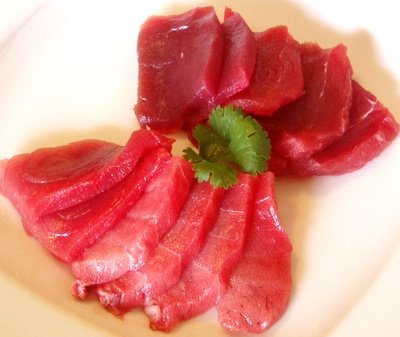
 Can you guess which types of tuna are on this plate?
I’ll tell you in a minute, but first let’s talk about tuna’s success story.
In the matter of a decade, this Rockefeller of fish, rose from rags to riches (or cans to sushi as we say in the fish world), drawing the looks of contempt, admiration, and envy from other fish. While salmon became the middle class of a fish – affordable, reliably available in any supermarket, and the token fish on restaurant menus – tuna has been making it big. It has grades, it has types, and it has that sexy rare center daring you to eat raw fish outside of a sushi restaurant.
“It’s sushi grade, right?” we ask our waiter as if to make sure it was blessed by the local sushi board similar to a rabbi declaring meat to be kosher. “Absolutely,” he replies nodding his head so confidently, you’d think he saw the sushi board stop by just a few hours ago to inspect the fish.
I still remember the first time I ordered a tuna steak, and the waitress asked me how I wanted it cooked. No restaurant has ever asked me to make that important decision about fish before and I was at a loss. After a few moments of hard thinking, I chickened out and ordered it medium-well. I felt as if one of my college friends offered me a joint and I turned it down trying to be the good kid. I'd eaten raw fish for years in sushi restaurants, but that was a totally different story. That was like drugs with prescription from a doctor. Raw fish in a regular restaurant, or God forbid in my house, seemed every bit as scary and illegal as recreational drugs.
Curiosity, of course, won over the fear of “unsupervised” raw tuna and I’ve been happily consuming it for the past 5 years with no adverse side effects besides temporary euphoria and random bursts of giggles. But besides gobbling up tuna tartare, sashimi, and steaks, I’ve also been reading a lot about this fascinating fish and bothering fishmongers with my never-ending questions.
Have you ever wondered what sushi grade really means? And what about all those other words like bluefin, yellowfin, big-eye, ahi, Number 1, Grade 1, etc. When I have a question that all my fish books fail to answer, I pick up the phone and call Carl Fantasia at the New Deal Fish Market. It’s amazing how much light a 10 minute conversation with Carl can shed on pretty much any seafood topic. Here is what I learned about tuna:
When it comes to top tier tuna (the steak kind you pay big bucks for vs. the stuff in a can), there are 3 species you are most likely to see in fish markets and restaurants:
- Yellowfin (also sold as Ahi)
- Big-eye
- Bluefin
Big-eye is much fattier and more flavorful than yellowfin. It retails for low $20s/Lb and at its prime can rival bluefin.
Bluefin is the Rolls-Royce of all tuna, prized for its bright red color, fattiness, and flavor. At its prime (the end of summer and early fall) when it swims north and fattens up, it can retail for close to $30/Lb. Not even the sushi restaurants can market this tuna effectively to the US consumers, and 99% of this lovely bluefin that we catch in the North Atlantic waters gets whisked off to Japan.
Correction about Ahi posted on August 7, 2006: I have written incorrectly in the original version of this post that Ahi is another name for Big-eye. That's what happens when you use Internet sources -- they aren't always right (except for Beyond Salmon of course ;) Thanks to Carl for finding this mistake. Ahi is a marketing term used for Yellowfin, not Big-eye tuna.
Of course, how good your tuna tastes depends not only on the species, but also on the season and even on each particular fish. That’s where the “grade” comes into the picture. When each tuna is caught, it gets pierced with a long probe and evaluated for color and fat content. The greasier the probe comes back, the higher the grade. Of course, it’s not a very scientific process, and what one distributor calls #1, the other might call 2+. The grades range from 1 (the best) to 3 (the worst). #1, 2+, and 2 all taste good enough to eat raw and can be sold for use in rare steaks, and sushi. This has nothing to do with the freshness of the fish, only with its taste. Since “#2+ Grade Tuna” sounds like they are serving you second grade fish, the restaurant menus will never use that terminology. They’ll either say “#1 Tuna”, or use the species name to describe it, like “Ahi Tuna.” Of course all these words don’t mean much, and you don’t really know how good that tuna is until you taste it. If this wasn’t complicated enough already, another variable in this tuna equation is the cut. The mid-section near the belly is the fattiest and most expensive, and the tail is the cheapest.
But what about the sushi grade? “Sushi grade” or “sushi quality” simply means the fish is fresh and has been properly kept on ice. A good fish market will take such care of all their fish and will be able to advice you on which fish are the freshest and good enough to eat raw. So “sushi grade” is more of a marketing term than a grade really. No authority gives this ephemeral “grade” out. Think about it this way. If you buy sushi carry out at a sushi restaurant, then take it home in a hot car on a summer day, and store it in your 42 degree fridge for a few hours, is that fish still “sushi grade”? So don’t worry about the grade. Worry about freshness. A really fresh tuna is easy to spot since it has no pearly rainbow discolorations, no smell, and no sleazy discharge. Buy it from a reputable fish market. Bring it home in a cooler with ice-packs, store it in the fridge (yes, still between ice-packs), and eat it that day. If you’d like a “sushi grade” certification, just give me a call. I’d be happy to issue one, after a thorough tasting of your tuna.
Keep in mind that the above advice only applies to tuna and a few other salt water fish. Most fresh water fish and some salt water fish are prone to parasites and are not safe to eat raw. So if you go fishing in the river, don’t serve that fish for sushi no matter how fresh it is.
Now that I’ve tortured you long enough, here is the answer to the tuna mystery…
The one on the top that is darker is bluefin ($18/Lb) from Court House Seafood and the one on the bottom that is lighter is big-eye ($22/Lb) from the New Deal Fish Market. How come the Rolls-Royce of tuna is cheaper than the big-eye? Bluefin is on the lean side right now and not at its best, though still better than tuna at most of Boston’s sushi restaurants. The big-eye, on another hand, is just spectacular. You see how pink it is? If you looked really closely, you’d see a spider web of fatty marbling running through its flesh making it melt in the mouth like sweet butter. This is as good as big-eye gets, or at least as good as I’ve ever tasted.
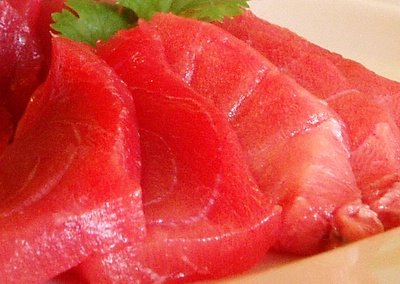
Mmmm -- fatty tuna...
Priceless.
For everything else, there is MasterCard®.


45 comments:
Very helpful. Excellent writing! Thank you.
Nice account on tuna Helen! I learned a ton!
This is some great information, Helen! Thank you! You are making me so jealous with those fatty tuna pictures, I need to find some!
Mmm.. fatty tuna. Couldn't have said it better myself. In fact you have rather inspired me to have sushi for lunch..
Hi Davalos,
You catch your own tuna? Lucky you :) How big are these guys? I hear some can be as huge as 200 Lb. Different varieties of tuna can co-exist in one area, so I don't really know which kind you might be catching. Here is a
tuna site with pictures and descriptions that might help you figure out which kind of tuna you catch.
Cheers,
-Helen
Hi Helen - We had to stop in after reading your tuna, pork, and salt blog entries - they are all excellent! We've been away for about a month, seems that your writing has improved greatly in that short time... very interesting and thorough - not to mention mouth-watering!
We were back in the South End today and stopped by Lynette's shop - they have all grass-fed beef, great-looking pork chops, VERY fresh chicken (on Wednesday they are walking around, on Thursday they are in the case), and the object of my desire - aged beef. We picked up a 5-month aged, one-lb new york strip (the owners recommendation) for a special date with a grill this weekend.
If in the South End, check out Lynette's on Tremont - you'll like their selections! Bring your wallet, as you can imagine!
Ok, keep it up. We miss writing but have just been busy.. thanks for your great posts!
sorry - LIONETTE Market in the South End.
At least you know I don't work there now!
Very helpful post.
And thanks for recommending Culinary Artistry--I love it. I like to make up recipes, and all those lists will be both helpful and inspiring.
Hi Boston Chef,
Thank you so much for the Lionette market recommendation.
You guys are all putting me in the mood for beef now :)
Cheers,
-Helen
I've always found it funny how American waiters get very excited about telling me their tuna is 'sushi grade'. I'd simply assumed that would only be important if I'd ordered sushi.
A great read. As one of those who wants to leave the raw tuna to the sushi experts I have been eyeing the tuna in the stores in the Vancouver area with curiosity. I learned a lot from you. Thanks :)
I've always wondered what was up with "sushi grade" (often said pretentiously) and other words people like to throw around like they know what they mean, like 'ahi.' Thanks for clearing it up!! I wish you would also include some recipes for preparation. Most restuarants seem to think encrusting it with sesame seeds or preparing it in some "asian" style is the only way to cook it. I marinate mine in lime juice, salt and garlic and then sear it and serve it medium rare. But it's the only way I know how to prepare it! I would love to have some recipes.
Hi Shimmy68,
There are basically 2 ways to prepare high quality tuna: raw or seared medium rare either on the grill or in a skillet. If you got something that's really fatty and yummy, I'd just slice it and serve it as sashimi. Otherwise, here are some ideas:
Tuna Tartare
Tuna with green bean salad and deviled eggs
Seared Tuna with pomegranate topping
Grilled Tuna
Cheers,
-Helen
Hmmm... I'm confused now. I did a Google search for "sushi grade" and found an AskYahoo page (http://ask.yahoo.com/20040513.html) that says sushi grade fish must be frozen for a period of up to 15 days before being eaten raw. Not just an aesthetic requirement, but one that apparently involves a health aspect too.
Also, I'm a fish biologist with a background in parasitology and wanted to comment on one thing in your article. You're half-right about eating freshwater vs marine fish, with respect to their parasites. Not just any marine fish is suitable for sushi, though. Rockfish, for example, (sold in California as "red snapper" or other names) is a marine fish that can be riddled with nematodes, and, if eaten raw or under-cooked (this goes for ceviche and other "cooking" methods that don't actually heat up the meat), can be quite a painful mistake... a condition called anasakiasis: worms burrowing their way through your innards. Ouch.
A good rule of thumb is to buy fish you're going to use for sushi from reputable dealers who sell "sushi grade" fish, for what that's worth...
Hi Jason,
You are right that the restaurants in US are required to freeze fish before serving it raw. Tuna is one exception. It's not prone to parasites, so it does not have to be frozen (though many places still freeze it). I did extensive research into parasites in fish issue. You might be interested in the following posts:
Parasites
in Fish (part 1)
Parasites in Fish (part 2)
Cheers,
-Helen
Thanks for the response, Helen. I guess my search for what determined "sushi grade" tuna was because I'd like to serve a seared ahi appetizer on Xmas eve. The question I had was whether the ahi sold at my local Costco was appropriate/safe (it's not labeled as sushi grade, of course). Sounds like it most likely is okay.
Thanks again. Happy holidays!
Good blog. Very tasty.
740
Hi Jason,
Great point. You couldn't be more right. I think what Helen might have meant to say was that virtually all freshwater fish are prone to parasites, whereas parasites in saltwater fish are (relatively speaking) less common. As you noted, it varies widely. Some saltwater fish (such as large tuna) are virtually parasite-free, but others (such as cod) are quite prone. It definitely pays to know what you're eating when you're eating raw meat!
Cheers,
The Other Jason (Helen's husband)
P.S. As I'm writing this, Helen is telling me that she wrote this post well before her posts on parasites, so when writing this (esp. the overly broad comment on saltwater fish) she wasn't nearly as well informed as she is now.
Hi Helen, Thank you for all the info on tuna. Just a note here, though: Bluefin tuna is overfished. In fact, the Montery Bay Aquarium's Seafood Watch program says, "Avoid bluefin tuna—they're severely overfished and fishing gear used to catch them entangle sea turtles, seabirds and sharks and endanger their populations." For all the details, you can check it out on the link I've pasted below: http://www.mbayaq.org/cr/SeafoodWatch/web/sfw_factsheet.aspx?gid=69
The Montery Bay Aquarium's Seafood Watch program evaluates the ecological sustainablity of wild-caught and farmed seafood commonly found in the US market. If you love fish AND the environment, it's a great reference site.
--LH
Could you please throw some light on what is sold as *super white* tuna?
don't know what "super white" tuna is, but "white tuna" is albacore tuna as far as I know. Sometimes, it is a name used for escolar, which has nothing to do with tuna.
Thank you Helen.
The last post was haphazard as I wanted to put it in before I went to bed! Your posts are so interesting I was reading it for 4 straight hours!
Actually super white is what they are selling as a tuna sushi item at a chain restaurant called oysy. They are (in)famous for selling a genetically unidentifiable *thing* as red snapper sushi in the restaurants according to one suntimes news group report.
Unfortunately on a limited college student budget - that's the only place we can go for sushi cravings in chicago.
Thus i asked...
You can also find pretty thorough description of what 'sushi grade fish' is at sushifaq.com:
http://www.sushifaq.com/sushi-grade-fish.htm
It's kind of interesting that it is more of a marketing term than an actual grading system.
Oh no! I just made (and ate) some seared tuna that was labeled as #1 Sashimi Grade, but it did have a pearl/rainbow discoloration. Is that really bad???
Hi Jennifer,
No, it's not really bad :) The pearly discoloration comes from the oils in the fish. All this means (as far as I know) is that the tuna was cut into steaks more in advance than you would ideally like.
But as long as it didn't have a fishy odor, you are fine.
Cheers,
-Helen
FINALLY an article that answered all my raw tuna eating questions! I am tired of paying primo prices at the japanese steakhouse for teensy chunks... off to the local fish market... away!!
Thank you, thank you, thank you!
Just found this blog, great recipes!!
We live on the Pacific coast of Costa Rica and having a sportfishing business are lucky enough to eat a lot of fish including plenty of tuna. Raw, seared, grilled, sushi rolls, tartare - you name it. Right off the cutting board to my mouth sometimes. What I did not know was the "marbly lines" are fat and actually a plus... we catch big eye and yellowfin here. They look the same from the outside when they are small, but the liver of the big eye has striations, the yellowfin does not. Both are delicious and we don't care which is which! ;-)
I'll be checking these pages for recipes, thanks!
-Petra
My question is - How often can you eat raw tuna?
I remember hearing tune has either hight mercury or high lead.
Is this true?
Yes, tuna has more mercury than most fish. Unless you are pregnant, you probably don't have to worry about it at all. If you are pregnant, you might want to limit your tuna consumption to a couple of times a month. If you can get good quality bluefin tuna more often than that, let me know where you live and I'll move there :) Here is a post I wrote about mercury in fish.
Thanks for the answer I needed (the first Google result for "bluefin vs yellowfin"). If you add to this blog, I suggest describing the differences in the various cuts of tuna, i.e., ootoro vs akami, and how they may vary with age (toro from a young tuna is never as fatty as that of a very old tuna).
Good info I just found:
http://www.seafood.net.au/intro/PDF-PU033-Intro.pdf
I lived in Japan for one year, and learned what to me then was a good deal about food only to come back hopelessly confused, trying to find the right translations and what was what, and so confused that I couldn't find that wonderful fancy fatty tuna. This website had been such fun, explaining so many things to me (like how 99% of that fabulous fatty bluefin goes to Japan) - and in easy English, no less! :)
Hi, great info here, I used to live in Japan and although I ate boat loats of sushi & sashimi and developed a love of it, especially toro and meguro, I never learned about it. Now I'm back home in Scary Eire, terrified to eat anything raw that I buy in an Irish supermarket. Im a food novice but I do know despite living on an Island nation we seem to know very little about fish...and eat even less. Can any Irish people advise me on where to get tuna fresh enough to enjoy uncooked? ... any help would be appreciated
Anonymous: tuna in Japan is maguro, meguro is just a train station ;)
this is a good blog. some notes - "white tuna" is not tuna, but escolar - avoid large portions. the rainbow color is just moisture coming to the surface. the cross section of the tuna acts like a prism. larger cuts = less oxidation = fresher. searing is always the way to go, but don't be afraid to treat it like a steak. the Oceanaire does a red wine reduction and sauteed mushrooms. very nice.
also, bluefin is endangered, but there are some "range tuna" available from west coast purveyors. fish are caught, and kept in large pens until they get bigger. not quite farmed, but not quite wild either.
-chuck mann- mpls, mn
Thank you so much for this information... I have always wanted to buy fish to make sushi, and this was extremely helpful. Ditto with the parasite pages (I came across this blog looking up worms... just found a worm in my cod).
I would have never have guessed that farm-raised salmon was better for eating raw! Or that I could eat sushi while pregnant! (well I'm not pregnant, but it's good to know). It's hard sometimes to find reliable info on the internet, thank you for sharing yours with us.
I stumbleupon'ed and digg'ed this post, I hope more people find it :)
This must be the best article on tuna I've ever read! Fantastic.
I love your funny and subtle writing style. A first class site I've bookmarked and will be returning to many times.
Thank you for making it available!
Andrew
One thing I thought I'd add about the perils of eating sub-grade tuna: I recently had an experience where, after eating a tuna burger at a local restaurant, I started having heart palpitations and my skin literally turned as red as a tomato. I thought I was crazy until I went to the ER and the doc told me about scombroid poisoning, which basically mimics an allergic reaction, and results from improper storage of certain fish (in this case, tuna). The interesting thing is, cooking the tuna does not help once it develops the chemical leading to the poisoning. I was okay, thankfully, but am much more cautious about my tuna.
Ahi is not a "marketing term" it's the Hawaiian word for fire, and they named yellowfin ahi because when they hooked them the fish dive so fast that the friction of the line on the gunnel of the boat would be so great it would create embers.
Steve Kahalewai
-Don't eat fish unless you caught it.
Sparker is correct. Ahi is a Hawaiian word used for both yellowfin and big eye tuna. This is not a marketing term at all. Once again internet knowledge cannot be trusted.
Also #1 grade yellowfin tuna(fat) is a fine substitute for both big eye and bluefin. We export all of our #1 YFT to Japan to be auctioned at the Tsukiji market. Most of the YFT sold to the US market are #2 or #3(steakers) and therefore YFT gets a bad name in the US. Just ask a fisherman for the straight dope next time.
There are some outlandish statements on this blog. First of all you state that the grading scale has nothing to do with the freshness of the fish, it's based on how it tastes. That's incorrect. The rating system is based upon two things, fat content, and color. A fish high in fat content and a deep red coloring is what is considered a high grade #1 Tuna. A Tuna that is low in fat, with varying shades of red to pink can be considered one of the lower grades: 2+,2,2- 3's are not sold anywhere. These fish are used for canning, and in some instances cut, CO treated, frozen, and sold on the frozen market. A grader bases nothing on taste of the Tuna. Never in the grading process is a taste test taken.
Secondly, Big Eye Tuna With Fat, is ideally what most Japanese sushi companies/restaurants look for. Big Eye #1 Tuna are desired, but not at the level of Big Eye Tuna With Fat. Yellowfin Tuna (Ahi Tuna, which literally means Tuna Tuna)makes up the majority of what people are eating in the US at their local sushi bars. 2+ YF Tuna is the desired level, some places have a higher standard and need #1, however 2+ is what is most common. #2 Tuna is used by processing facilities when they cut fish, CO treat, freeze, and resell on the frozen market as steaks and loins.
BTW when someone mentions SUSHI GRADE Tuna, what they are referring to is the COLOR of the Tuna, not the taste. It's all about color. The average restaurant goer has a major misconception about what Sushi Grade is referring to.
How do I know? Been in the frozen and fresh fish business for 27 years, and I am a sales rep at one of the top seafood importing companies on the East Coast.
Hi there Anonymous,
I think we might be agreeing more than disagreeing. Most people who know tuna don't need to taste it to guess how good it will be. They can tell by fat and color. To say that the amount of fat has nothing to do with taste seems strange to me. What I was trying to say is that number 1 tuna doesn't gradually become number 2 after it sits around for a while. It's a grading system that's established up front.
About CO2 treatment. It's common event for sushi fish, though I hear that O2 works better. Not sure if it's done for fish in Japan, but I know suppliers who do it for sushi fish in the US.
Sushi grade in the US and Japan are very different things. The only way something can be officially labeled "sushi grade" in the US is if it was previously frozen. Tuna might be an exception because it's not parasite prone. These days many upscale restaurants are serving raw fish that does not have official "sushi grade" designation.
Greetings! I've been following your site for some time now and finally got the courage to go ahead and
give you a shout out from Humble Tx! Just wanted to say keep up the excellent work!
Also visit my blog burn fat
I normally don't comment on these types of blogs but i just had to on this one after reading the comment that eating sushi tuna a few times a month when pregnant is okay, and another blogger accepting that info. If pregnant, never seek info from online bloggers. Only your doctor can tell you what is safe and all OBGYN's i know say no tuna, except the can stuff and only rarely. All I'm saying is if you're baby ends up with brain damage, the blogger that said it was okay is not going to be able to help you, so only take advice from your DR when determining what is best for your unborn child.
Fresh tuna flavors can vary widely, and aging techniques seem to enhance the taste even more. Interesting breakdown of the process. Thanks for sharing.
Post a Comment